|
COINS
AND BANKNOTES
(During
the Russian Empire and after the Revolution of 1917)
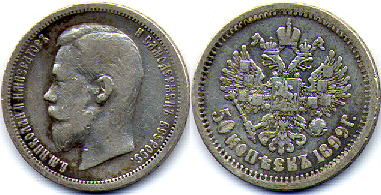
Nicholas II Tzar
of Russia, 1894-1917 AD
Silver 50 Kopeks, 27 mm. - Dated 1899
A.D. - St. Petersburg mint
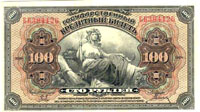
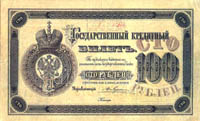
The
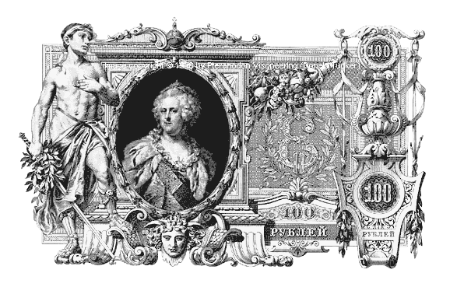
100 Ruble banknote of 1910
From the late 18th century
until 1917 the Krim (Crimea) peninsula and the mainland portion of Taurida
Oblast (province) was part of the Russian Empire, and used Russian currency.
The Russian empress who conquered the territory -- Catherine II (known as
Catherine "the Great") -- was memorialized on Russian currency,
along with notable Tsars such as Peter I (also honored with "the Great").
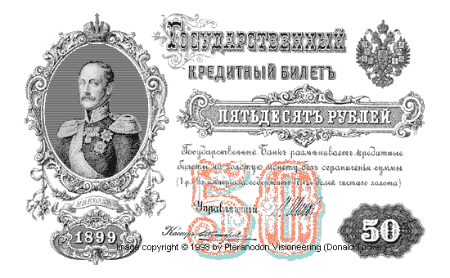
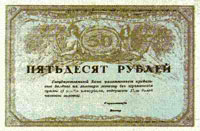
Imperial
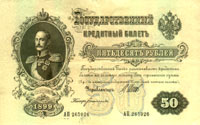
Russian designs for paper money were generally of high quality. This classical
design, with a portrait of Tsar Nicolas, is for a 50 Ruble banknote issued
in 1899.
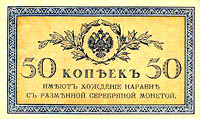
Most commerce in Imperial Russian Crimea/Tauridia was conducted with smaller
denomination currency. In the period just before the Great War this included
coins valued in Rubles, Kopecks and fractional values of Kopecks:copper: 1/4,
1/2, 1, 2, 3, and 5 Kopecks / Silver: 5, 10, 15, 20, 25, and 50 Kopecks /
Gold coins: 5, 10 Rubles. It also included paper money valued at 1, 3, 5,
10,25, 50, 100, and 500 Rubles.
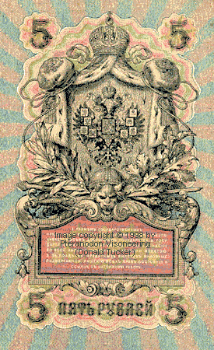
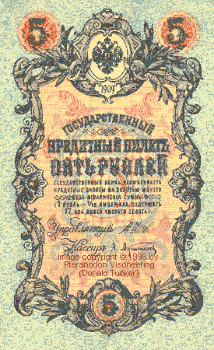
The 5 Ruble banknote
of 1909
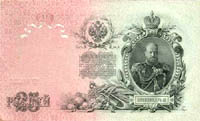
Imperial Russian designs
for paper money were generally of high quality, including this beautifully
designed 5 Ruble banknote of 1909
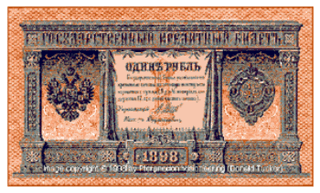
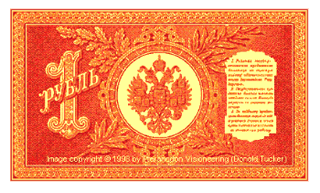
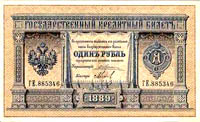
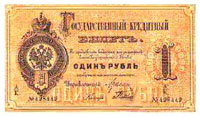
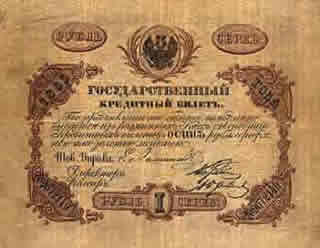
The one Ruble
banknote
Imperial Russian designs
for paper money were generally of high quality. However, the one Ruble and
Kopeck notes were issued with utilitarian designs of little artistic merit.
On the one Ruble note the architectual motif is reduced to the facade of a
nondescript generic structure.
1917
-1918 1918
1917
915
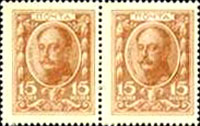
- 1917 stamp currency 1915
fractional notes 1905
- 1917
1898
- 1899 1892
- 1896 1887
- 1892
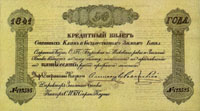
1843
- 1865 1840
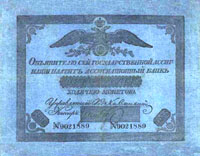
- 1841 1818
- 1840
[HOME] [BACK
TO CURIOSITIES]
|