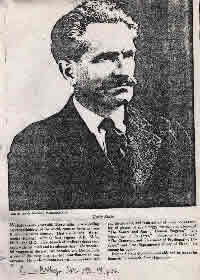
BORIS SIDIS
Biographical Sketches
(Courtesy: H. S. L.Harry S. Linenthall)
 |
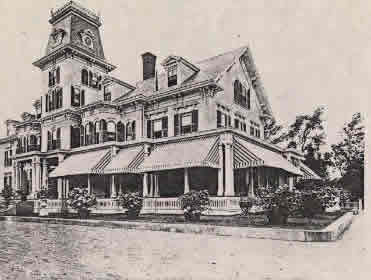 |
Born in Berditchev, Russia Oct. 12, 1867. At age of 17 imprisoned by Czar as political prisoner, for teaching peasants to read, against Czarist law. Released and escaped to America 1887. AB Harvard 1894; AM 1895; PhD 1897; MD 1908. Assistant in Aristotelian Logic, Harvard 1896. Appointed by Gov. Theodore Roosevelt to Associate Psychologist and Psychopathologist, Path. Inst. N.Y., State Hospitals 1896 -1901. On endowment from Gordon Bennet established in 1901 Psychopathological Hospital and Psychopathic Lab. of New York Infirmary for Women and Children with Julia de Forest etc. Returned to Boston received MD and in practice 1909. Called by Dean of Chicago University to found Criminology Institute of Chicago University in 1908. In 1909 given estate in Portsmouth New Hampshire by Whittemore.
Founded Sidis Psychotherapeutic Inst. Was assoc. editor Archives of Neurology and Psychopathology; editor Journal of Abnormal Psychology founded for him by Morton Prince. His main "work involved the treatment of private patients. Started while in New York the general reform of Mental Institutions.Effects felt around the world. Great advances made in treatment of criminals. Died in Portsmouth New Hampshire after attack of influenza from an old ailment contacted while in prison in Russia.
Note: These
few paragraphs, found on a single typewritten page in Helena Sidis's files,
contain facts not found in the published bios of the man. This suggests
it may have been written by Dr. Sarah Sidis-Dan Mahony
Boris Sidis,
an Appreciation Harold Addington Bruce (Journal
of Abnormal Psychology, 1923, 18, 274 - 275.)
A notable figure
passes from the inter-related fields of normal and abnormal psychology with
the death of Boris Sidis. The prediction indeed may be confidently made that
as time elapses it will increasingly be recognized that the world is much
in Sidis's debt for the larger knowledge now possessed regarding the nature
and possibilities of human personality. Sidis was one of the first to undertake
really scientific exploration of the subconscious region of the mind, and
his findings therein were both varied and of practical importance. His formulation
of the law of reserve energy and of the principal factors in suggestion, his
demonstration of the value of the hypnoidal method as a means of gaining access
to the subconscious, his exposition of the part played by the self-regarding
instinct and by over-development of the fear instinct in the causation of
psychopathic maladies, would alone suffice to give him a conspicuous place
in the history both of psychology and of scientific psychotherapy. And Boris
Sidis put to his credit these various achievements under circumstances which
emphasize his genius.
Although all of his scientific work was done in the United States he was by birth a Russian, and he came to this country at the age of twenty as a friendless and almost penniless immigrant. This was in 1887. After a period of vicissitudes in New York he was accepted as a student of Harvard College, where he received his A.B. degree in 1894. In the meantime the young Russian had attracted the friendly attention of William James, was encouraged by the latter to specialize in the study of psychology, and in 1897 was made doctor of philosophy. That same year Sidis's first important book saw publication, "The Psychology of Suggestion." To that book Professor James contributed an introduction, in which he paid a generous tribute to its author's originality. From Harvard, Sidis returned to New York to accept the position of associate in psychopathology in the then recently established Pathological Institute of the New York State Hospitals.
Here he remained several years, developing his method of hypnoidization and effecting impressive cures in cases of functional nervous and mental disorder. Of these the most interesting psychologically was the "re-association" of the Rev. Mr. Hanna, victim of an amnesia so complete as to constitute a remarkable instance of secondary personality. The detailed record of this case Sidis made available in his book, "Multiple Personality," written in collaboration with Dr. Simon. P. Goodhart. A little earlier had appeared his "Psychopathological Researches in Mental Dissociation," with chapters contributed by Dr. George M. Parker and Dr. William Alanson White, the latter now superintendent of St. Elizabeth's Hospital at Washington. In 1904 Sidis removed to Brookline, Massachusetts, to engage in the private practice of psychotherapy, to gain a medical degree from Harvard Medical School, and to continue his scientific researches.
Of the several papers and monographs that he published while in Brookline the most important is his" Studies in Psychopathology" (first appearing in the Boston Medical and Surgical Journal), with its statement of the law of reserve energy as explanatory of psychotherapeutic cures and as indicative of possibilities yet unrealized in the way of individual and racial development. During his Brookline sojourn also appeared Sidis's significant "Experimental Study of Sleep," verifying Claperède's theory of sleep as a protective rather than recuperative device, and setting forth the major requirements for sleep-production as established by Sidis's own experimental work on animals and human beings. Five years were passed in Brookline. Then, in 1909, Sidis opened in Portsmouth, New Hampshire, a sanitarium for the treatment of nervous affections.
Thereafter he was chiefly active in the practice of psychotherapy, though he found time for some experimental work, contributed important articles to the JOURNAL OF ABNORMAL PSYCHOLOGY (of which he was an associate editor) and published a trilogy of books setting forth the basic principles of normal and abnormal psychology and of the causation of psychopathic maladies as they appeared to him. His death occurred suddenly, from cerebral hemorrhage, the morning of October 24, 1923, with but the slightest premonitory indication that he was not in his usual excellent health. From a personal friendship of nearly twenty years the writer can bear testimony that Boris, Sidis was, to those who enjoyed intimate acquaintance with him, one of the most genial and kindly of men as well as a scientist of real distinction and a highly original thinker.
But, of a retiring nature and absorbed in the problems of his work, he did not encourage anything in the way of a "following" of pupils to disseminate his findings and his doctrines. Nor was he in frequent contact with fellow-workers. Add an uncompromising intellectual honesty that impelled him to a blunt outrightness with regard to whatever seemed to him erroneous or mischievous, and it is not difficult to understand why during his lifetime Boris Sidis did not enjoy the full measure of recognition which he merited, and which it would seem certain will eventually be accorded to him.
More about Boris Sidis, by H. A. Bruce
BORIS SIDIS was born at Kieff, Russia, May 6, 1868, the son of Moses and Mary (Marmor) Sidis. He died at Portsmouth, N.H., Oct. 24, 1923. He married Sarah Mandelbaum, and they had one daughter and one son, William James Sidis, who entered Harvard at the age of eleven and was graduated cum laude at the age of sixteen with the Class of 1914.Sidis came from Russia to the United States at the age of twenty, a friendless and almost penniless student. After a period of vicissitudes in New York, he spent two years and graduated with our Class. After three years in the Graduate School be took his Doctor's degree. He received friendly encouragement from William James, who contributed an introduction to his first book.
For several years he served as Associate in Psychopathology in the Pathological Institute or the New York State Hospitals. Afterwards he engaged in the private practice of psychotherapy, first in Brookline, and later in his sanatorium for the treatment of nervous affections at Portsmouth.He was of a retiring nature, and his absorption in his work and a bluntness springing from his intellectual honesty and independence, prevented his obtaining the following and recognition his distinction and originality deserved. To his intimate acquaintances he was one of the most genial and kindly of men (IX, 102: H.A.B.)
Note: This one-page unpublished MS may be part of a draft for Bruce's The Riddle of Personality, perhaps Chapter 9, page 102, published in 1915 by Moffat Yard. Source: Houghton Lib., Harvard, Boris Sidis's papers. It is stamped with the number 688 - Dan Mahony
Other references about Boris Sidis
William James Sidis was born on April Fool’s Day, 1898, to Sarah and Boris Sidis.
Boris and Sarah Sidis were Russian Jewish immigrants, 19-year-old Boris and two of his friends arriving in 1886, and 13-year-old Sarah and her father booking passage in 1887. In his hometown of Berdichev, Boris “knew several languages, was well versed in history, and composed poetry that was put to music by the townspeople of Berdichev*”. The intense, young Boris was characterized by a hatred for ignorance and tyranny, and a passion for learning and teaching. At the age of seventeen, he was imprisoned for defying a Czarist ukase against teaching the peasants to read, and was imprisoned for two years in a body-sized cell. Rather than consuming him, the fire tempered him. After he was released from prison, he and two other pobrecitos absconded to “America”.
Sarah Mandelbaum and her father, Bernard, fled Russia after the family was robbed and savagely beaten by a band of thugs.
Although the emigrants’ families had prospered in Russia, they were initially reduced at first to grinding poverty in America, but it wasn’t long before they had improved their lots in life. Within a few years, Boris, already reputed to be a genius, was making a living teaching English to fellow immigrants for a dollar a student a week. Sarah had a job as a seamstress in an expensive dress shop. They met in 1891, when Sarah became one of Boris’ English students. “She was awestruck by him. He seemed to her infinitely wise, learned, and kind.
“Under Boris’ tutelage, Sarah nurtured her dream of becoming a doctor. Medical school was the favorite ambition of European immigrants, and the schools’ tuition fees were payable in installments, bringing the dream within reach of a dedicated few. Still, in 1891, only a few dozen European immigrants had become doctors in New York, and none of them were women.*”
Boris encouraged Sarah to pursue her medical ambitions. Buoyed by Boris’ assessments of her ability, she passed the New York State Board examination for high school students with flying colors after studying for it only three weeks. Sarah, in turn, urged Boris to enroll at Harvard. Boris resisted, citing his contempt for academic red tape and the meaninglessness of formal degrees. But Sarah prevailed.
Once there, Boris fell in love with Harvard’s stimulating atmosphere. He received his Bachelor’s Degree in one year, in 1891 and his Master’s Degree in two years, in 1892! He also fell in love with Sarah, and the two of them married in 1892, the same year Sarah matriculated at Boston Medical School. Their tiny, two-room, attic apartment became a Sunday-afternoon center for the nascent field of psychology.
While Boris was in New York, Harvard requested that he submit as a Ph. D. dissertation the article upon which he was working. Boris refused. Harvard relented, asking him to come to Cambridge for his Ph. D. orals. Again, Boris refused. Finally, Harvard waived formal requirements for the Ph. D., and sent Boris his sheepskin through the mail!
The mountain had come to Mohammed.
William James said of it to Sarah, “They wouldn’t do this for me… If they call me a genius, what superlative have they reserved for your husband?*”
A stiff-necked idealist, Boris eschewed money, and more often than not, refused to charge his patients for his services. Both he and Sarah were extremely strong-willed.
Meanwhile, Sarah had become “one of a handful of women to graduate from medical school before the turn of the century*”. She was also pregnant with Billy.
One conclusion suggests itself: both Boris and Sarah were surpassingly brilliant. It seems unlikely that even undue diligence could propel someone through Harvard in one year, and earn him a Harvard Ph. D. without fulfilling formal requirements unless he were perceived to possess a prodigious intellect. (You wonder how Boris and Sarah would have compared with Billy on an IQ test. They weren’t as precocious as Billy, but then, they didn’t have themselves as parents.) Sarah was controlling to the point of being domineering.
From
H. A. Bruce, The Riddle of Personality, Moffat Yard, 1915, 88-93
Equally impressive,
as testifying to the value to the new methods of treating mental alienation,
is the work of Boris Sidis, the Janet of the United States. And first a few
words as to Dr. Sidis's career, in itself most interesting. Of Russian birth,
he came to this country when still extremely young, and entered Harvard. It
was not long before his industry, his alertness, and, above all, his originality,
attracted the attention of Professor James, who conceived a hearty admiration
for the young Russian and prophesied that he would be heard from after leaving
Harvard. This prophecy was speedily fulfilled with the publication of his
"The Psychology of Suggestion," which made it evident that a remarkably
gifted investigator and thinker had entered the scientific field. About this
time, too, opportunity knocked at Dr. Sidis's door in most unexpected fashion.
Acting on the recommendation of Dr. Carlos F. MacDonald, president of the
State Lunacy Commission, the New York Legislature had created a novel department
of governmental activity, a "pathological institute."
This was intended to be, so to speak, an educational annex to the State hospital system, its chief legal raison d' etre being that it might "provide instruction in brain pathology and other subjects for the medical, officers of the State hospitals." But, as luck would have it, a progressive and liberal-minded physician, Dr. Ira van Gieson, was appointed director, and the institute speedily developed into something more than a mere hospital appendage. Dr. van Gieson, who deserves to be ranked among American pathfinders of the subconscious, saw clearly that as then constituted psychiatry (the study of insanity) was in a dismal slough of despond and could make little progress until the problems of insanity were approached from other than the purely medical standpoint. To this end he gathered about him a staff of specialists in allied sciences, and as associate in psychology and psychopathology he selected Dr. Sidis. It was in 1896 that the institute began work in earnest, and by 1899 Dr. van Gieson could report to the State Commission that "much material has been accumulated by the director and his associates, and many scientific generalizations of theoretical and practical importance have been worked out."
Among these generalizations was Dr. Sidis's now famous "law of dissociation" which has thrown a flood of light on the mechanism both of insanity and of suggestion, and which we shall presently survey in brief. But if Dr. van Gieson might justly feel proud of the results obtained in so short a time, it was none the less certain that the commission was dissatisfied with his conduct of the institute. Criticism hinged on the fact that he was subordinating the educational to the experimental phase, and he was urged to pay more attention to the work of instructing the asylum physicians. In vain he protested that "the main function of the institute is the investigation of the principles and laws of abnormal mental life."
He was reminded that the act creating the institute contemplated other objects. A bitter controversy developed, and in the end he and his associates were swept from office with their work unfinished, and the institute was reorganized on a "practical" basis. For a time the little band of investigators found refuge in a private laboratory, but ere long lack of funds caused their dispersal, Dr. Sidis removing to Brookline, Mass., where he continued his scientific work, to no small extent centering his efforts on elaborating the law of dissociation.
1. Dr. Sidis
is now (1915) conducting a sanitarium at Portsmouth, N. B., the Sidis Psychotherapeutic
Institute.
NOTES
Mrs.
Martha S. Jones, of Boston, Mass., has presented her estate and magnificent
parks near Portsmouth, N. H., to Dr. Boris Sidis, of Brookline, Mass., for
the purpose of establishing a private hospital, to be named 'The Maplewood
Farms, Sidis Psychotherapeutic Institute,' in which modern methods of psychopathology
and psychotherapeutics will be employed in the treatment of functional nervous
diseases. The hospital will open in the early spring.[Psychological Bulletin,
1910, 7, 75.]
Boris Sidis, A.M.
1895; Ph.D. (Philos.) 1897; M.D.1908 (Harvard Medical School).
Formerly Associate in Psychology and Psychopathology at the Pathological Institute
of the New York State Hospitals.
Director of the, Psychopathic Hospital and Psychopathological Laboratory of
the New York Infirmary for Women and Children.
Member of the American Psychological Association.Secretary of the American
Psychopathological Society.
Member of the American Institute of Criminal Law and Criminology.Editor of
The Archives of Neurology and Psychopathology.
Associate Editor of The Journal of Abnormal Psychology. (In Harvard Alumni
Association's Quinquennial Catalogue, 1910.)
Information
from the family
Who's Who in America, 1022-23; Harvard Coll. Class of 1894 (privately printed 1919); H. Addington Bruce, Boris Sidis - An Appreciation, Jour. of Abnormal and Social Psychology, Oct. - Dec. 1923.
SIDIS, BORIS (Oct. 12, 1867-0ct. 24, 1923), psychologist, was born in Kiev, Russia, the son of Moses and Mary or Elizabeth (Marmor) Sidis. His family was in comfortable circumstances, and he was tutored at home under the direction of his father until the age of seventeen, when he was sent to a government school at Kishinev in southern Russia. While there he was arrested for political reasons along with a number of other students, subjected to solitary confinement, and then sent home where he remained under police surveillance for several years. He finally came to the United States in 1887 and settled in New York City. Being without funds, he worked in factories and gave private lessons for a living, and in his spare moments studied in the public libraries. In 1892 he entered Harvard as a special student. In 1893 he was regularly enrolled, and received the A.B. degree in 1894, the A.M. in 1895; and the Ph.D. in 1897. He was married in 1894 to Sarah Mandelbaum, and they had two children. At Harvard he attracted the attention of William James [q.v.], and it was undoubtedly due to James and Hugo Münsterberg [q.v.] that he became interested in psychology.
In 1898 he published his first book, The Psychology at Suggestion, an attempt to explain the nature of the subconscious, especially in relation to personality. The ideas he formulated on the subject of dissociation formed the basis of his future work. William James wrote a complimentary preface to the book, describing it as an original work, although he could not agree with all of Sidis' contentions. Sidis returned to New York to accept the position of associate psychologist and psychopathologist in the recently established Pathological Institute of the New York State Hospitals from 1896 to 1901. While there he developed the method of treatment of functional psychoses and obtained some interesting cures. In 1901 he became director of the psychopathic hospital laboratory of the New York Infirmary for Women and Children.
He published his Psychopathological Researches, Studies in Mental Dissociation in 1902, contributions by Drs. G. M, Parker and W. A. White being included. He advanced the theory that psychoses were due to mental dissociations. One of his most interesting cases, the reassociation of the Rev. Mr. Hanna, who was suffering from amnesia and who had acquired a second personality, is described in his book Multiple Personality, written in collaboration with Dr. S. P. Goodhart, and published in 1905. In 1904 Sidis returned to Massachusetts and settled in Brookline where he spent five very active years, studying medicine at the Harvard Medical School, practising psychotherapy, and continuing scientific research. Among the papers he published was "Studies in Psychopathology," in the Boston Medical and Surgical Journal, Mar. 14, to Apr. 11, 1907, in which he described his theory of nerve energy in connection with psychotherapeutic cures.
An Experimental Study of Sleep (1909), based on research performed in part at the Harvard Medical School through the friendly cooperation of Dr. W. B. Cannon, attempted to prove that monotony and limitation of voluntary movements tend to raise the threshold of psychomotor activities, and thus cooperate in the induction of sleep. In 1908 he received the M.D. degree from Harvard. In 1909 he established the Sidis Psychothapeutic Institute at Portsmouth, N. H., where he continued to practise until his death. The Psychology, of Laughter appeared in 1913, and expounded the Freudian idea that forms of inferiority excite laughter. In his Symptomatology, Psychognosis, and Diagnosis of PsychopathicDiseases (1914), however, he takes issue with the Freudian doctrine. In the same year he published The Foundations of Normal and Abnormal Psychology, and in 1916, The Causation and Treatment of Psychopathic Diseases.
Sidis had very active and forceful mentality. In addition to his special subject, he was an ardent student of political economy, philosophy, and languages. He possessed a genial and kindly nature, but was apt to express his opposition to what he considered fraudulent or dishonest with abruptness and vigor. He was of a retiring disposition, and did not seek a following of pupils. He made few contacts with his colleagues, but the few friends he did make, among them Morton Prince [q.v.], were his loyal admirers.
[HOME] [BACK TO OTHER REFERENCES]